“For King and country. The following men of this parish have joined his majesties forces since the declaration of war. Colonel Sir Lovelace Stammer. John Radford-Norcop. Percy Jones, Royal engineers. Arthur Glassey, James Morrey, Henry Morrey, Joseph Morrey. Herman Fisher. Joseph Mottram, Oliver Chidlow, John Malkin, Edward Ratcliffe, Sam Swire, Alfred Boughey.”
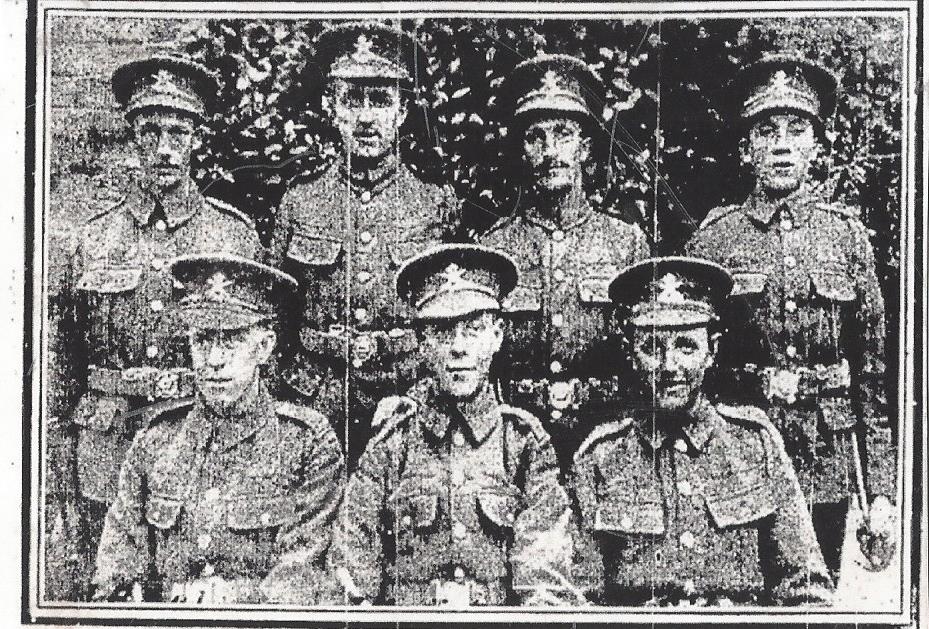
George Bloor, Edgar William Silvester, Robert Holding, and Joseph Bloor.
(Sitting): J. Buckham, James Moffat and Arthur Thomas Silvester.
An interesting Letter from a Norton in Hales Solider – The following is an extract taken from a letter written in the trenches on 2nd May 1915 and received by Mary Ann Smith, formerly Glassey living at 42 Forge in Norton in Hales. The writer, Private Thomas Glassey belongs to the 2nd Cheshire’s, son of Mr William Glassey of Norton in Hales. “Just a line in answer to your most welcome letter just received. Dick and I hope you are all well as it leaves us both very well at present. I have written and told you I received your parcel all right. I suppose you have received it by now. Dear Sister I suppose you will be surprised to hear that I have heard from brother Will. He is in the Shropshire Light Infantry and out here at the front; he is on the right of me in the 21st division, so he is not far off me, but I can’t get to see him. He never told me anything about his wife or his family affairs; I suppose he was fed up with civil life, but he is a brave man leaving his wife to fight for his King and country and a home for himself. Father will be proud having four sons fighting for the country. I am sure our family are doing their share in his great war; but what puzzles me is why those fellows at home keep going on strike for more wages: I wish I could see them I would tell them a little bit. Let them come out here and try this work: they would be glad to go home and will make ammunition and x it cut to us and we will do the rest. Nobody knows what the war means to England only them who have a share in it – it’s either win or die. Germany must be crushed and we are the boys to do it; so cheer up, we are all right. I suppose you would like to know where I am writing this letter. Well, I am in the trenches, about 30 yards from the Germans. They don’t give us much rest, but we are not afraid of them. You must thank Mrs Meadows for the socks she sent; they were a blessing to me; in fact, I could do with some more. I haven’t had a chance for nine days, so I hope you will send some more. Tell C I have received the cigarettes she sent me. I was pleased when I got them. I hadn’t had a smoke for five days, so you can tell they were acceptable. We have been in the trenches for ten days now and they boys quite enjoy it, they don’t mind as long as they get a smoke and plenty to eat. You can show this letter to Mr Meadows if you like I suppose he would like to see how the boys from his rifle club are going on. Well I must close this short letter, because it is going dark and we are just going to ‘stand to’ for the night. You know there is no sleeping at night the ‘allemands’ will not let us sleep; they might creep up and take our trench, so we have to be on the alert.
Private William Glassey (16203), 2nd Battalion King’s Shropshire Light Infantry. Born 1878. William enlisted in December 1914 at Shrewsbury. He was one of 10 soldiers killed in action on 8 May 1915 at Frezenburg Ridge, 3 miles north east of Ypres, during an enemy artillery attack.He is remembered on Panel 47 and 49 at Ypres (Menin Gate) Memorial. He left behind a widow, Elizabeth Glassey formerly Lloyd and his children; James, Lawrence William, Winifred Jessie, Agnes Phoebe and Robert Charles.
Private Thomas Glassey (9201), 2nd Cheshire Regiment. Born 29 April 1888. Thomas and Richard enlisted on the same day 16 April 1909 at Chester, long before WWI. In 1911 he was serving with the military at The Ridge, Jubbulpore, India. Thomas was taken prisoner at Ypres; records show him detained in the Giessen Prisoner of War camp in July 1915. The War Office reported him as ‘Missing’ on the 14 April 1916 Casualty List. He survived captivity, was demobilised on 4 April 1919, married Caroline Mary Powell at Norton-in-Hales on 20 April 1919, and by 1939 was a farm bailiff at White Barn, Shugborough Hall. He died in Dorset in 1967 aged 79.
Corporal Richard Glassey (9202), 2nd Cheshire Regiment. Born 11 June 1889. In 1911 he was serving with the military at The Ridge, Jubbulpore, India. He contracted malaria in 1915 and was hospitalised. Was in France Jan 1915 to October 1915, Egypt from October 1915 to November 1915 and Salonika November 1915 until the end of the war. Richard died in 1961 in Whitchurch, aged 71.
Arthur Glassey. Born 12 May 1895 and was the youngest son of William and Phoebe Glassey of Norton-in-Hales. In 1914 he was named in a contemporary newspaper among the men of Norton who had joined His Majesty’s Forces. Arthur was the youngest of four Glassey brothers known to have served during the First World War, alongside William, Thomas and Richard. His brother Thomas, writing from the trenches in May 1915, remarked that their father would be proud to have “four sons fighting for the country”. Arthur survived the war and died in 1970.
Lieutenant Joseph Henry Bloor (1228), Gordon Highlanders. Born 1897. Joseph was the younger brother of George William Bloor. When Joseph enlisted on 17th May 1915 at Stoke on Trent, his address was Brook House, Norton in Hales, his occupation listed as farm labourer. On 13th November 1916, Joseph was awarded the Military Medal for gallantry in leading his men in the attack on Beaumont Hamel, when a German general was among the prisoners captured. on the 21st November 1917 where upon he won the Military Cross whilst serving with the 1st/8th Sherwood Forester’s.
Private George William Bloor (201989), “H” Battalion Tank Corps. Born 1892 at Norton in Hales. George was the son of George and Annie Bloor. In 1911 the family were living at Charn Cottage, Norton in Hales. Private Bloor was killed in action during the France–Flanders campaign on 23rd November 1917. Age 25. He is remembered on Panel 13 at Cambrai Memorial, Louerval – Pte George Bloor was born in Norton in Hales in Shropshire. He originally served with the Royal Field Artillery and deployed to France in Nov 1915. he transferred to the Tanks in early 1917 and was killed in action on 23 Nov 1917.
Alfred Boughey (3670, 3357), Life Guards, Guards Machine Gun Regiment. Born 1897, he was the son of Alfred and Mary Boughey. When Alfred enlisted in 1919, his address was given as Brand Common.
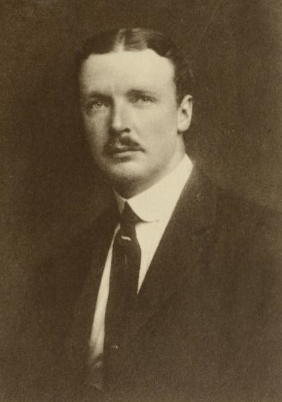
Captain Henry George Coulson Colville, 1st Battalion King’s Shropshire Light Infantry. Attached to. H.Q. 16th Infantry Brigade. Born 1886. Henry Colville was the son of Hugh Colville and Agnes Colville, formerly Davenport, of Bellaport Hall, Norton in Hales. Henry enlisted in 1906. On 27th August 1914, Henry aged 28 married Marjorie Eleanor Nantes at North Cerney, Gloucester. Henry was killed in action during the France-Flanders campaign on 22 September 1915 Aged 29 years. Captain Colville was one of six officers who died during intense hand-to-hand fighting at the Battle of Hooge. He is buried at La Brique Cemetery at Plot 1, Row 1, Grave 21. “
Temporary Second Lieutenant Charles Emerson Clouting, 1st Battalion, The Buffs v East Kent Regiment. For conspicuous gallantry on the night of the 21st September 1915, near Forward Cottage, when on patrol duty with Captain Colville. 1st Shropshire Light Infantry. Captain Colville was shot within 15 yards of the German sap which they were reconnoitering, and, although Second Lieutenant Clouting endeavored to drag him back, he was unable to do so. It was uncertain whether Captain Colville was still alive, and, after the return of the patrol, a rescue party was led back by Second Lieutenant Clouting. He found Captain Colville dead, and, recognising that numbers would be a source of danger, he sent all his party back except Sergeant Baker. These two crawled back under heavy fire, dragging the body with them. There was a bright moonlight at the time.”
Guardsman William Forrester (20182), 4th Battalion The Grenadier Guards. Born 1895, son of George Forrester, Stockman, of 66 Brand Common, Norton in Hales. Forrester died of wounds at Bethune aged 20 years on 17 October 1915, about which time the 4th Battalion occupied complex communicating trenches alongside the Hulluch-Vermelles Road. He is buried at Choques Military Cemetery at Plot 1, Row G, Grave 69.
Gunner Robert Holding (1274), Machine Gun Corps, Motor Machine Gun Service Royal Artillery. Born 20 July 1888, Robert was the son of John and Mary Holding. In 1911, Robert a groom was living with his parents at Oakley Forge, Robert Holding died in 1977 aged 89.
Arthur George Jones (K36635), Born 15 February 1890 the older brother of Reginald Kent Bishop Jones. He joined the Navy in 1916 and served on HMS Victory II and HMS Barham.
Sapper Reginald Kent Bishop Jones (1248, 486485), Royal Engineers. Born 1893, Reginald was the son of John Bishop Jones. In 1911, the family were running the Hinds Head Inn, John’s occupation is listed as motor mechanic. In 1917 Reginald married Doris Lucy Thompkinson. Sapper Jones died at the Regimental Command Depot, Thetford of influenza on 4th November 1918. Aged 25 years. He is buried at Brighton (Bear Road) Cemetery at Grave ZGV. On 13 July 1919 his son Reginald Henry Bishop Jones was born.
Gunner Herbert Roland Keay (170977), Royal Field Artillery. Herbert Roland Keay was born at Norton-in-Hales in 1898, the youngest son of William Henry Keay and his second wife Elizabeth Light of Brook Farm, Mucklestone Road. The Keay family had farmed at Brook Farm since the nineteenth century, but Herbert chose a different career and, as a young man, worked as a telegraphist for the North Staffordshire Railway. Aged eighteen, Herbert enlisted at Newcastle-under-Lyme in 1916 and joined the Royal Field Artillery as Gunner 170977. His enlistment papers record his father William Henry Keay of Brook Farm as his next of kin and include character references from Andrew Rock of the North Staffordshire Railway and Sir Lovelace Stamer of Betton Hall. Herbert was transferred to the 69th Divisional Artillery in December 1916 and later served in France. His surviving military papers record a posting to 168th Brigade RFA in 1918. While on active service he was admitted to a field hospital suffering from diarrhoea before returning to duty. He survived the war and was awarded the British War Medal and Victory Medal. Following demobilisation Herbert returned to his railway career. In the 1921 census he was again living at Brook Farm and working as a railway clerk. His father died that year and, following the death of his mother Elizabeth in 1922, Brook Farm was sold, bringing the Keay family’s long association with the farm to an end. In 1926 Herbert married Phyllis Nellie Chadwick. Having begun his railway career as a teenage telegraphist and later worked as booking clerk at Norton-in-Hales station, Herbert eventually rose to become Deputy Controller at Liverpool Lime Street Station. He retired in 1959 and subsequently moved to New Zealand.
Lieutenant Colonel Sir Lovelace Stamer, Baronet. Born 4 April 1859. Lovelace was educated at Harrow and Trinity College Cambridge. He joined the 16th Lancers in 1881 and served in India, retiring as major in 1899. During the Boer War he served with the Reserve of Officers and in WW1 with the Imperial Yeomanry. Lovelace was jutice of the peace for Staffordshire. In 1911, living at Betton House with his wife Eva Mary Stamer, daughter Isabel Eva Stamer and their servants, his occupation is given as late major 16th Lancers. Lovelace Stamer died in 1941.
Private John Edward Malkin (10624), 5th Battalion King’s Shropshire Light Infantry. Born 1892 at Norton in Hales, John was the son of John Malkin (Villiage Clerk) and Ellen Malkin, of 51 Norton-in-Hales. John was killed in action on 25 September 1915 The Battle of Loos), during an enemy bombardment of trenches at “Railway Wood” near Ypres. Aged 24 years. He is remembered at Panel 47-49 at Ypres (Menin Gate) Memorial.
Guardsman Herbert Morrey (21395), 3rd Battalion The Grenadier Guards. Born 1890, Herbert was the son of George and Ann Morrey, at Bellaport, Norton-in-Hales. In 1911 Herbert was living at Folly Lodge, Oakley Park, with his mother and grandmother, his occupation is listed as gardener. Guardsman Herbert Morrey was killed in action aged 25 on 17 October 1915 (The Battle of Loos) about which time the 3rd Battalion was being shelled as it occupied trenches on the Hohenzollern Redoubt. Heavy casualties were suffered, totaling 19 Officers and 500 Non Commissioned Officers and men, including all four Company Sergeant Majors. He is remembered on Panels 5-7 at Loos Memorial.
Corporal John Morrey (23608), 17th Battalion The Lancashire Fusiliers. Born 1895, John was the son of Frederick Morrey and Annie Morrey, formerly Martin. In 1911 the family resided at 17 Main Street, Norton-in-Hales and John was working as a farm labourer and was boarding with the Owen family at 60 Brand Cottages. He was killed in action during the France-Flanders campaign on 5th May 1917. Aged 22 years. Corporal Morrey is buried at Vadencourt Cemetery at Plot 1, Row B, Grave 18.
Private William Morrey (24886), 6th Battalion Kings Shropshire Light Infantry. Born 1882 at Norton in Hales to Elizabeth Phoebe Morrey. In 1911 William married Florence Alice Jones. Private William Morrey was killed in action on 3rd March 1917 in France and Flanders.
Corporal Albert Edward Pruce (17362), 6th Battalion Kings Shropshire Light Infantry. Albert was the husband of Alice Annie Pruce, of 45 Norton-in-Hales. He was killed in action during the France-Flanders campaign on 16 August 1917 Aged 29 years. Corporal Pruce was one of 42 of his unit killed at the Battle of Lanquemark, 5 miles north of Ypres. He is remembered on Panel 112 to 113 at the Tyne Cot Memorial.
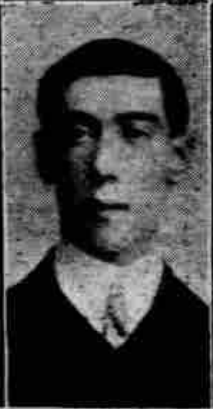
Captain John Radford-Norcop Esq (23608), 8th Foot Staffordshire Yeomanry. Born 1877 at Etwall, the only son of Arthur Radford, of Smalley, Derbyshire. On 22nd May 1910, John married Phyllis Thornton the daughter of Colonel Walker Thornton, at St Chad’s Church, Norton in Hales. At the time of his marriage he is discribed as a late Lieutenant of the King’s Regiment. In 1911, John was living at Brand Hall with his wife Phyllis Radford-Norcop and their servants. During WW1 he served in Egypt.
Second Lieutenant Philip Colin Rawson, Princess Charlotte of Wales’s (Royal Berkshire) Regiment Born 1897 at Norton in Hales, to Philip Heathcote and Lillie Campbell Rawson. In 1901, Philip and his family were living at Brand Hall, Norton in Hales. While nineteen-year-old Philip Rawson was serving with the Royal Berkshire Regiment on the Western Front, his elder sister Barbara was nursing wounded servicemen at Greenhill Hospital in Sherborne. On 28 September 1915 Philip was killed at Fosse 8 during the Battle of Loos. His body was never identified and his name was later inscribed on the Loos Memorial, CWGC Cemetery/Memorial Pas de Calais, France, Panel 93 to 95.
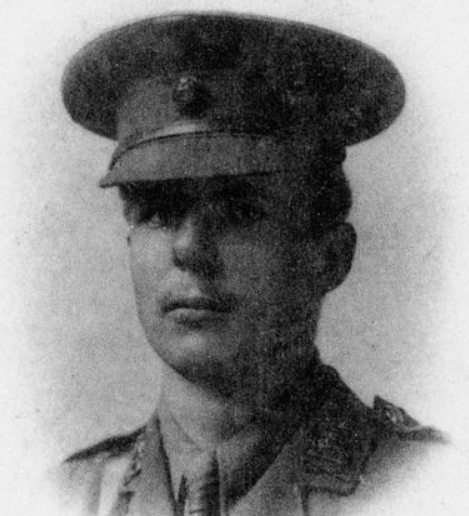
Private Cecil Harry Rudd (22007), 2nd Battalion The Grenadier Guards. Born 1894, Cecil was the son of Arthur and Emma Rudd of 76 Bellaport, Norton in Hales. Harry enlisted at the of January 1915 and was killed in action on 1st December 1917 about which date the 2nd Battalion was in action near Gonnelieu. He is remembered on Panel 2 at Cambrai Memorial, Louerval.
Gunner Arthur Thomas Silvester (1340), Machine Gun Corps (Cavalry and Motors). Born 1889, Arthur was the son of George and Jane Silvester, formerly Hall. In 1911 Arthur Thomas, a butcher was boarding with the Rathbone family at 20, Norton in Hales. On 3rd August 1914 Arthur married Sarah Reynolds Stephens (a Cook at the Rectory) at St Chad’s Church, Norton in Hales. Arthur Thomas Silvester died in 1981 aged 92.
Gunner Edgar William Silvester (1344), Machine Gun Corps (Cavalry and Motors). Born 1892, Edgar was the son of George and Jane Silvester and the younger brother of Arthur Thomas Silvester. In 1911, Edgar a Wheelwright, was living at 55 Main Street with his widowed father and siblings, Percy, Lily, Archie and Nellie. On 23 January 1927 Edgar married Edith Annie Peake at St Chad’s Church, Norton in Hales. Edgar Silvester died in 1960 aged 68.
George William John Southerton (8362), Air Mechanic Royal Flying Corp. Born 1896, he was the son of George and Sarah Southerton. In 1911 he occupation is listed as apprentice joiner and was living with this widowed mother, uncle and nephew at 35 Main Street, Norton in Hales. He was discharged on 13 March 1917. On 13 January 1931, at 39 Main Street, Norton in Hales George died.
Private Samuel Cottrell Swire (3127, 300426), Staffordshire Yeomanry (Queen’s Own Royal Regiment), Corps of Hussars. Born 1896 at Norton in Hales to Thomas Humble Swire and Mary Ann Swire. On 16 September 1926 at St Chad’s Church Norton in Hales Sam married Margret Lillian Craddock. In 1939 Sam Swire and his wife Margaret Swire were living at Poultry Farm, 80 Bellaport Road. He then served the village again during WWII as an ARP warden
Private John Benjamin Thomas (14659), Duke of Cornwall’s Light Infantry, Dorset Regiment. Born 1890 at Bellaport, Norton in Hales, the older brother of Harry Thomas and son of Benjamin and Hannah Thomas of Bellaport Gardens. In 1911 was a boarder 22 Blechynden Terrace, Southampton, his occupation is listed as a steward on the SS Adriatic. Private John Thomas died 20th November 1915 . He is remembered at Carnoy Military Cemetary.
Lance Corporal Harry Thomas (12503), 9th Battalion The Sherwood Foresters (Notts and Derby Regt.) Born 1st November 1891, Bellaport Gardens, Norton in Hales. 1891 at Bellaport, Norton in Hales, son of Benjamin and Hannah Thomas; Benjamin Thomas was a local gardener. He was employed at Osmaston Manor gardens before enlisting in Derby. Lance Corporal Thomas died on 21st August 1915 (Gallipoli). When Harry died at Gallipoli, the 9th Sherwood Foresters suffered a cluster of fatalities. Harry appears alongside at least thirteen other men of the battalion killed that same day. He is remembered on Panel 150 to 152 at Helles Memorial, Turkey.
Wilfred Thomas (131689), Royal Air Force. Born 1900 at Bellaport, Norton in Hales. Wilfred was the son of Benjamin and Hannah Thomas and the younger brother of John and Harry Thomas. In 1911 he was living at 81 Bellaport Gardens, Norton In Hales, Market Drayton. He served in 1918.
Corporal William Woodcock,14th Battalion The Hampshire Regiment. Born 1888, William was the son of John and Mary Woodcock then of Brown Hills, Market Drayton, and the husband of Faith Bickley of 7, Old Farm, Lilleshall, Newport. He died at No. 3 Canadian Casualty Clearing Station from a gunshot wound to the chest on 1 February 1917, aged 29 years. Corporal Woodcock is buried at Lijssenthoek Military Cemetery at Plot X, Row D, Grave 46.
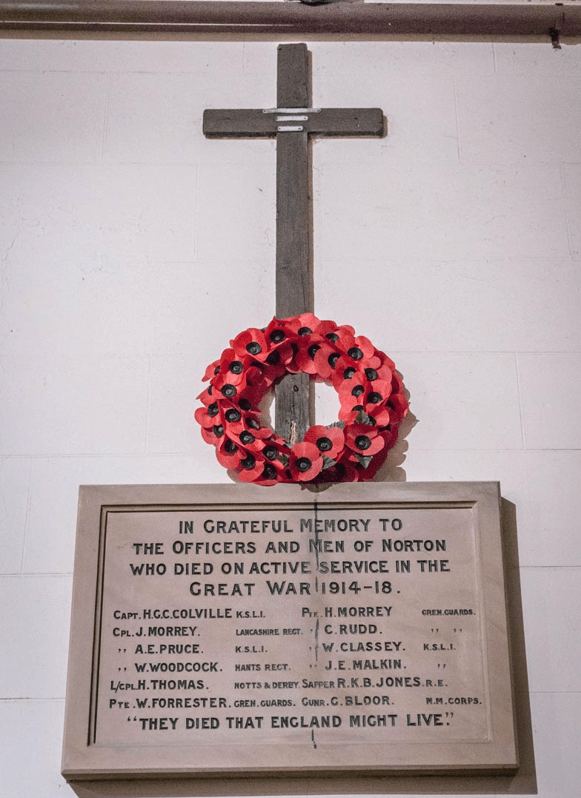
Norton in Hales – Proposed War Memorial. At a public meeting of parishioners held on the 20th November 1918, it was unanimously decided that a memorial of the British Victory in the Great War and a Tribute to those from the Parish who have fought for that Victory should be erected in Norton in Hales Village, and that every effort should be made to build a Parish Hall, as a worthy and lasting Memorial that will be an Ornament to the Village and of Social and Educational benefit to present and future Parishioners. It is realized that the cost will be great, at least £1,000, but the committee feel sure that every Parishioner will give freely in accordance with his means as a thank-offering for deliverance from the horrors of War in this country and in many cases as an acknowledgment of the increased riches that have been vouchsafed to him. The following committee was elected at the above meeting and any member will be glad to receive at an early date the promise of your Subscription. Payment should be deferred until a later date and may be made in two or more installments at your convenience. Mr F. Bourne, Mrs Chadwick, Mr F. Crewe, Captain Heathcore, Mr A. W. Jones, Mr W. H. Keay, Mrs Meadows, Mrs A. Morrey, Captain J. Radford-Norcop, Mrs J. Radford-Norcop, Mr M. Palmer, Reverend D. Roberts, Mr T. H. Swire, Mr J. Meadows (Hon Tres) and Mr C. Chadwick (Hon Sec).
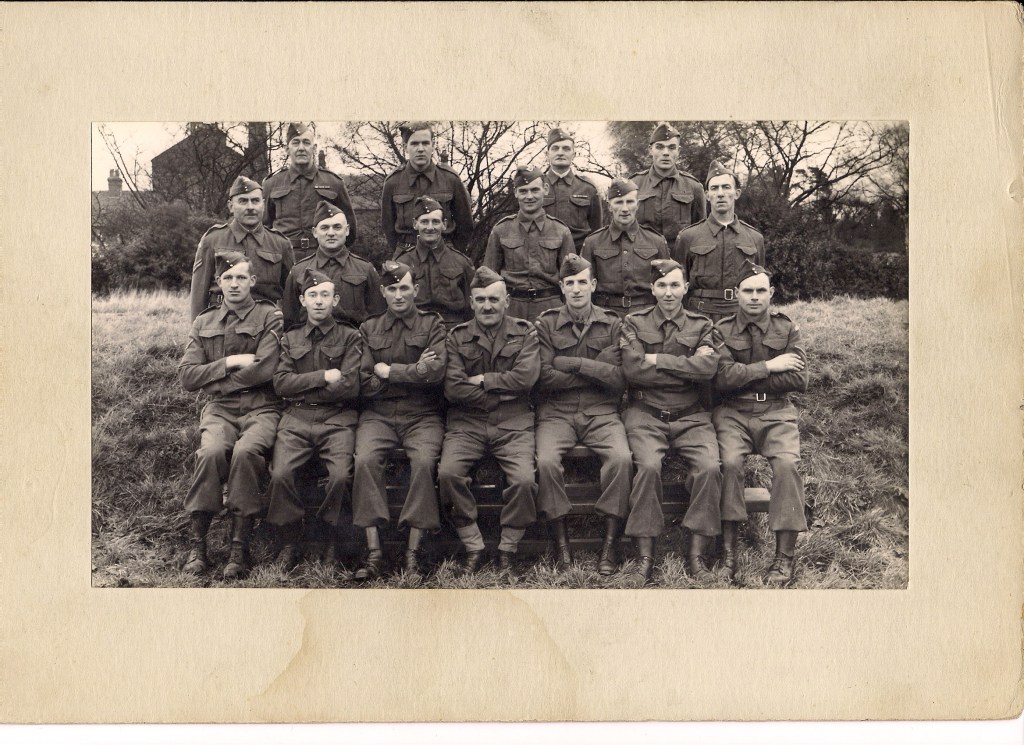
George Powell. Fred Powell. Jack Woodcock. Steve Healy
Tom Swire. Alf Batho. Harold Wrench. Joe Davis. Bert Davis. John Bloor.
Wilf Eardley. George Simon. Fred Rochel. Sam Swire. Les James. Bert Rathbone. George Hudson.
Samuel Cottrell Swire A.R.P Warden
Flying Officer Ralph Kenyon Crompton, 611 Squadron Royal Air Force. Born 18 March 1916, Ralph was the son of Ralph Crompton and Josephine Helen Kenyon Crompton of Betton Hall, near Norton in Hales, and was one of two brothers who died whilst serving as RAF Pilots. He attended Charterhouse from 1930–33 and joined the Auxiliary Air Force, being commissioned in November 1937. He served continuously with 611 (West Lancashire) Squadron. He was married to Ellen Mawdsley Crompton, of Tarporley, Cheshire. On the morning of 2 June 1940, 611 Squadron flew twelve Spitfires to Dunkirk as part of a wing that also included 32, 66, 92 and 266 Squadrons. Between approximately 8:05 and 8:25 a.m., Ralph’s Spitfire N3064 was engaged by German Bf 109s and Bf 110s and shot down. It crashed at Fort Mardyck beach, west of Dunkirk harbour. He was killed during the final stages of Operation Dynamo while RAF fighters were protecting the evacuation. Flying Officer Crompton was 24 years old. He is buried at Etaples Cemetery, France at Plot 46, Row C, Grave 17.
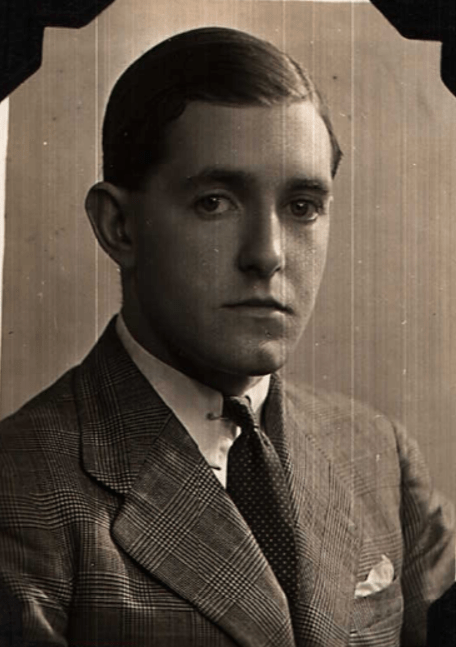
Squadron Leader John Anthony Crompton (74668). Born 21 August 1919, John was the son of Ralph Crompton and Josephine Helen Kenyon Crompton, of Betton Hall, near Norton in Hales, and was one of two brothers who died whilst serving as RAF Pilots. John was a junior scholar at Charterhouse and later attended Brasenose College, Oxford. He joined the RAFVR and rose from Pilot Officer through Flying Officer and Flight Lieutenant to acting Squadron Leader. He initially served as an armaments instructor before becoming a pilot with 603 (City of Edinburgh) Squadron. On 23 August 1943 he was flying Beaufighter VI JL625 ‘R’, with navigator Sergeant Henry George Griffiths, when the aircraft was hit by anti-aircraft fire near Zakynthos (Zante), Greece, and crashed into the sea. The men were initially buried on the island and later reinterred at Phaleron War Cemetery near Athens, where John lies beside his navigator. Squadron Leader Crompton was 24 years old. He is buried at Phaleron War Cemetry, Athens, Greece at Plot 5, Row D, Grave 14.

Philipp Richardson Crompton DFC & Bar, AFC (72250). Born 10 July 1917, was the second son of Ralph Crompton and Josephine Helen Kenyon Crompton of Betton Hall. Like his brothers Ralph Kenyon and John Anthony Crompton, Philipp was educated at Charterhouse, where he was a pupil in Verites House between 1931 and 1936. He later attended Brasenose College, Oxford, and represented Oxford University at football in 1938. All three Crompton brothers would go on to become officers in the Royal Air Force during the Second World War. Philipp was commissioned as a Pilot Officer in the Royal Air Force Volunteer Reserve on 5 April 1938, service number 72250, and subsequently served as a bomber pilot. By 1941 he was serving with No. 9 Squadron RAF, flying operational bombing missions over occupied Europe. His courage was recognised early in the war. On 11 February 1941, while an Acting Flight Lieutenant with No. 9 Squadron, Philipp was awarded the Distinguished Flying Cross (DFC). He subsequently served with No. 7 Squadron RAF, one of Bomber Command’s leading heavy bomber squadrons. One particularly remarkable incident occurred during an attack on Düsseldorf in September 1942. After crossing the Dutch coast, Philipp’s bomber was attacked by an enemy aircraft and sustained numerous hits. Despite the serious damage to his aircraft, Squadron Leader Crompton continued towards Germany, reached Düsseldorf and successfully bombed the target before managing to fly his damaged aircraft safely back to Britain. His wartime career saw him rise rapidly through the ranks. He became a Flight Lieutenant, Temporary Squadron Leader in June 1942, War Substantive Squadron Leader in August 1943 and subsequently Acting Wing Commander. He was also Mentioned in Despatches in January 1944 and, in the King’s Birthday Honours of June 1944, Acting Wing Commander Philipp Richardson Crompton DFC was awarded the Air Force Cross (AFC). On 18 October 1940, Philipp had married Cecily Muriel Orton at Christ Church, Harrow. She was the daughter of Brigadier Sidney Bernard Orton CB of the Indian Army and Muriel Julia Eddis. Philipp and Cecily subsequently had two daughters. After surviving the war, Philipp returned to civilian life and became an Executive Director of James R. Crompton & Brothers, the family’s paper manufacturing business. Philipp Richardson Crompton died in June 1981, aged 63.

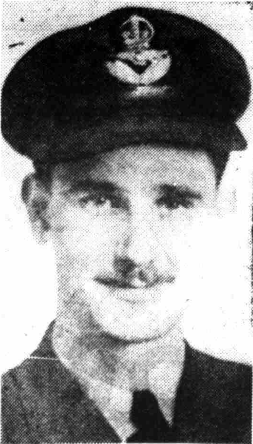
Flight Lieutenant John E. Wilkins. The Western Daily Press and Bristol Mirror, Monday, November 22nd 1948 – Mrs Wilkins, wife of Flight Lieutenant J. E. Wilkins, sole survivor of the British airlift Dakota crash in the Soviet boarder last night to visit her husband in Schoeneberg Hospital. At the frontier they were met by a Soviet Officer who took the British officers place. Soviet authorities waived all travel formalities. A British doctor from Luebeck had been in Schoeneberg Hospital since Saturday after this injured officer was reported to have a good chance to pull through, although still dangerously ill. Bodies of the three men killed in the crash were brought to Luebeck yesterday and arrangements to salvage the aircraft were begun. Mrs Wilkins lives at Norton in Hales, near Market Drayton Shropshire. An official announcement said that she was expected to remain in the Soviet zone for two days. John Wilkins died on 26th of November 1948.